Friday, 31 January 2014

Goodbye, 2013 Books!

January 31st, 9:43 pm: Is this the last possible moment to present a roundup of everything I read in 2013? It may well be. Although the calendar is an arbitrary thing, January still belongs to Old Year/New Year comparisons, while tomorrow--February already--represents slogging through the slush of remaining months. So tomorrow will be too late.

I've been thinking about my list for a few weeks, and not quite typing it out. One problem is that I haven't kept a reading journal, so I had to reconstruct my year in books. I might have missed some, especially short fiction daily zapping around the Internet, stories from heaven, and hell.

A more mundane problem is household noise. Yakking kids, barking dog, TV in the background. Here's a little slice of our soundscape this evening: the History channel, which should be fine for young people, right? Let the educational bonanza begin. Except "History" was inexplicably running a show called Ancient Aliens, complete with so-called experts discussing star portals--whatever they may be--in Lake Michigan. And I was proud of, if a tad distracted by, the derisive hoots coming from my offspring. They know their history from their sci-fi, unlike the network programmers who are even now violating the terms of their broadcast licence.

At the moment, things are calmer. My son is watching the old film My Cousin Vinny, one of our faves. It's still in my ears, though, still slowing me down. I'll do my best to keep the inflections of the stern Southern judge character (played by the hilarious Fred Gwynne of The Munsters fame) and Joe Pesci's smartass Brooklyn lawyer out of this report to the world.

The thing about this list is how random it seems, even to me. It's the result of a mysterious combination of bookstores I wandered past, short stories I found online and in journals, book club dictates, and my abiding interests in food, migration, and big data/surveillance. Not included are books that I gave up on. At a glance, my list appears to be weighted toward Americans with some British and Canadian writers in the mix and achieves a rough balance between male and female writers, as well as fiction and non-fiction. Pure happenstance, all of it. Still, tracking reading habits is an exercise worth doing, if only to assess how scarce hours disappeared.

Allow me to introduce, and say goodbye to, my 2013 reading list. Here, in no particular order, are some books and stories you might want to read yourself.

Fiction
  • The Thousand Autumns of Jacob DeZoet by David Mitchell: I'm slowly working my way through all of Mitchell's books. His Cloud Atlas is an inspiration (and the film version, while entertaining, doesn't touch that book's magic).
  • 419, by Will Ferguson: winner of the 2012 Giller Prize, featuring a global plot sparked by Nigerian telecom scams.
  • The Age of Miracles, by Karen Thompson Walker: first novel about a girl and her family coping (and not coping) when the earth's rotation begins to slow.
 
  • John Henry Days, by Colson Whitehead: This may have been the novel of my year. It's not a new book (found in a in a New York bookstore bin), but I couldn't stop thinking about its intriguing thematic structure--spokes of narrative arrayed around the hub of a cultural icon, John Henry. It's funny and angry. The open-to-interpretation ending almost killed me. 
 
  • NW, by Zadie Smith: wonderful, find my notes here, and I'll be rushing to get her new work, The Embassy of Cambodia.
  • A Visit from the Goon Squad, by Jennifer Egan: read on vacation, long after everyone else had stopped gushing (for good reason) about it.
  • Tinkers, by Paul Harding, a gorgeous, compressed meditation on fatherhood that also manages to be rich in character and incident; winner of the Pulitzer Prize in 2010 and somehow I never heard of it until September 2013.
  • Beatrice & Virgil, by Yann Martel--allegorical animal stories within the story.
  • The World Without You, by Josh Henkin: a family gathers for a memorial service for their son, a reporter killed covering the war in Iraq, and navigates the aftermath of grief.
  • Notable short stories:
    • Alice Munro's To Reach Japan
    • E.L. Doctorow's A Writer in the Family
    • Emma Donoghue's The Widow's Cruse*
    • Mia Alvar's The Kontrabida*
    • Amity Gaige's The Soul Keeps the Body Up*
    • several stories from Edith Pearlman's collection, Binocular Vision; and
    • a strange story called Birds in the Mouth by Argentinean writer Samanta Schweblin, translated by Joel Streicker, and recommended by PEN America on the Recommended Reading website.
 * These all appeared in the literary journal One Story, itself a huge find. Must renew subscription.

Non-Fiction
  • Food Rules: An Eater's Manual, by Michael Pollan: short and sharp, find it here.
  • Hungry for Change by A. Haroon Akram-Lodhi: examines the connections between hunger and obesity; the capitalist transformation of food production; and ways to address the global subsistence crisis, which affects us all. I loved learning about the ties between seemingly unrelated people and circumstances, such as Haitian and Lousiana rice farmers.      
Hungry for Change

  • How to Write a Sentence: And How to Read One, by Stanley Fish: bought in e-book format and, while it was engaging enough for this word nerd, I'm glad I didn't spring for the hard copy.
  • The Devil's Highway, by Luis Alberto Urrea: beautifully written account of a disastrous journey through the Arizona desert by a group of migrants in 2001. No surprise, it's tragic. A finalist for the Pulitzer, the book also has the distinction of being among a group of similar-themed works banned by Tucson district schools.
  • Black Code: Inside the Battle for Cyberspace, by Ronald J. Deibert: I'm still immersed in this book, which came out before the Snowden revelations. It details many cases of cyber-espionage and hacking that University of Toronto's The Citizen Lab, which Professor Deibert leads, has uncovered. Everyone should read it. 
  • Finally, I must include How to Expect What You're Not Expecting: Stories of Pregnancy, Parenthood and Loss, edited by Lisa Martin and Jessica Hiemstra, because encountering the wide-ranging, poetic voices of the other contributors was a revelation.

Wednesday, 29 January 2014

DIY Dairy

No, not milking cows. The title refers to do-it-yourself dairy products. I've been wanting to try making yogurt, sour cream, cream cheese and more ever since launching this slo-mo, haphazard Unprocessed Project a year ago. Homemade ricotta cheese, our first dairy experiment, turned out to be ridiculously easy.

I'm not ready to tackle yogurt, which requires both cooking and prolonged, temperature-controlled resting. But soon. Making your own yogurt sounds so hippie-ish, doesn't it? Pity that I was born too late to be a hippie.

Today's kitchen lab featured a less ambitious dairy project: sour cream made with a recipe from The Home Creamery--and, credit where it's due, I found this book through one of my favourite blogs, Obscure Canlit Mama.

The process is simple: mix some buttermilk into light cream. Cover and let stand 24 hours in a warm place. Stir, refrigerate another 24 hours to thicken, and then it's ready...we hope! I'll report back if disaster results. Meanwhile, here is the sour-smelling concoction warming in the cupboard over the heat vent, the only cozy spot in our drafty old house.


I was feeling a sense of accomplishment on the unprocessed food file this afternoon, having made not only the sour cream, but also brownies, hummous, and two kinds of scratch pizza, regular and beet-green. And then my son asked if we had any ranch dressing (for the pizza crust). Which of course we did not. And that was simply one dish too many. I invited him into the kitchen ("step away from the computer"), and the rest is edible history.

Joe's creation
Postscript: Anyone trying to feed a family based on Michael Pollan's 5-ingredient food rules will be defeated by the average supermarket dairy aisle. Most commercial dairy products contain long lists of ingredients, including milk protein concentrate (likely imported, made from milk possibly containing the synthetic growth hormone rBGH, which is banned in Canada but not the U.S.) and additives to extend shelf life, thicken, or emulsify, such as guar gum and carrageenan. Why not duck all that? 

Sunday, 26 January 2014

Competing with Squirrels

Just over a year ago, I posted these pictures without explanation and never returned to the topic.


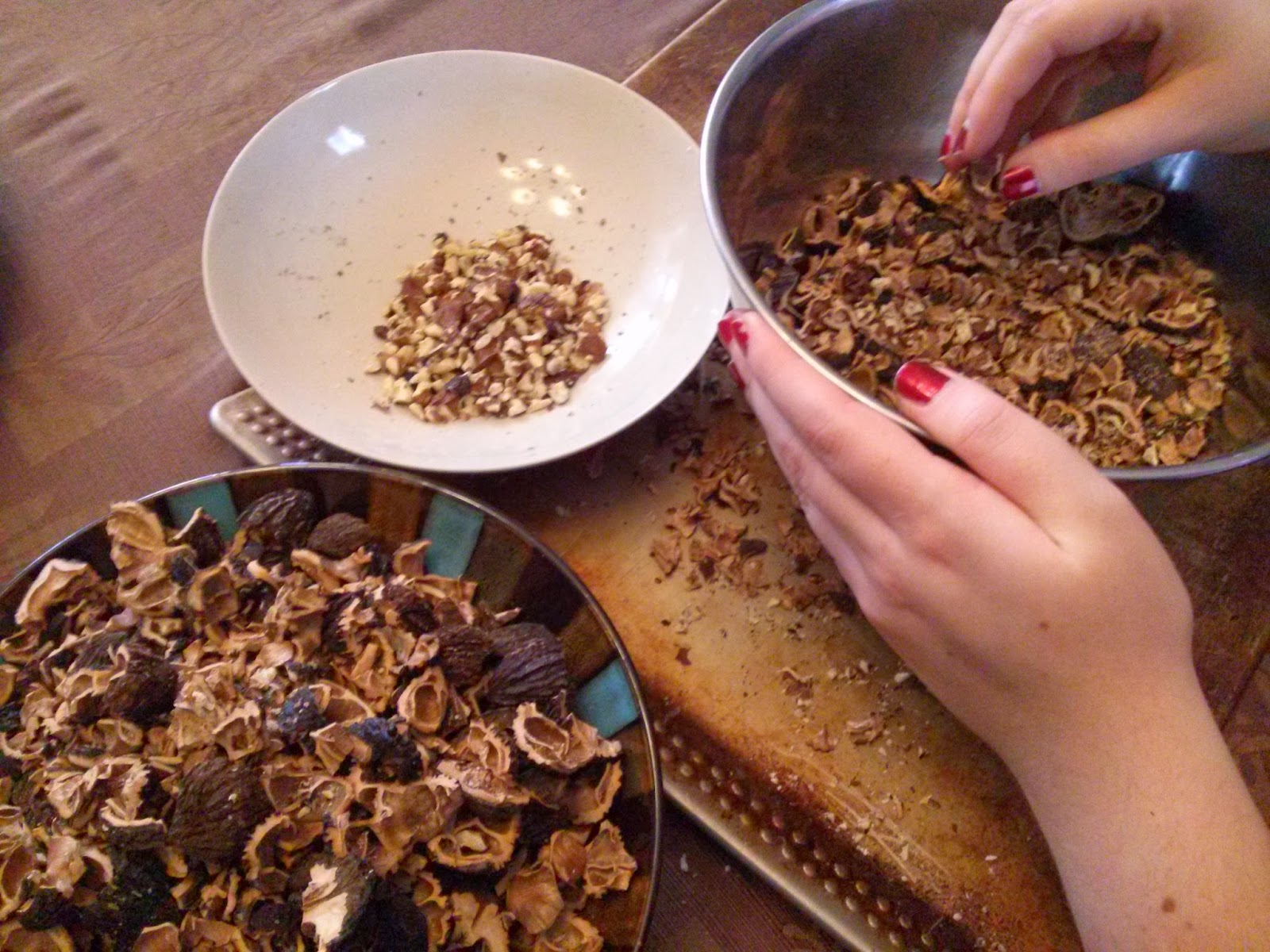
Perhaps it was because we were too busy dealing with this particular topic in the material realm. An overflowing topic, claiming space in boxes and pails, presenting itself as a chore that could be assigned to wayward children. They took turns--short turns--crushing nuts and sorting bits of shell from nutmeat before rebelling, quick to point out that they don't even like walnuts. Why do we collect them, anyway?

Yes, why: I don't know why. It has something to do with not wanting to waste nature's offerings. Our yard is surrounded by gorgeous black walnut trees that annually drop fruit at our feet. It also feels right to enact a ritual from earlier times. My paternal grandmother would have known what to do with all these nuts. My father (operating on genetic memory?) advised wearing gloves when peeling the green outer hull to avoid staining our hands black. So far, we haven't made our own dye, but that's an idea, too.

For my husband, who does 99% of the collecting and crushing, this extraordinarily labour-intensive activity is a race against his enemies. Every nut collected is one denied to the squirrels. He lives to defeat them, whether it's defending the bird feeders from rodent raids or, more recently, live-trapping and moving to friendlier territory the squatters nesting inside the ceiling of our mudroom (in the old summer kitchen, not inside the house proper, but still, ick...we could hear them up there, having a raucous party...they can't live with us, amIright?).  

So, here we are, one year later, sorting shells again. (And happy blog anniversary to me: 48 posts, not bad for the first year of an experiment, if I do say so myself.)

eldest daughter fails to employ walnut-avoidance tactics of her siblings
You, too, can harvest black walnuts and get free food. This tutorial will help. Thank you, friendly YouTube guy teaching us from Hamilton, Ontario. (Note: if the clip does not appear below, find it here.)


Somewhere online I read that people drive over the nuts to crush them, but that seems extreme, and our driveway isn't paved. The hammer method works. Tim wraps the nuts in cloth and demolishes a bunch all at once, but before the hammer, he tried crushing them with his vice, which broke. The shells are really, really hard.

I use the nuts in baking. Last year, we even had a few jars to give to relatives, to whom I offer a sincere and belated apology for any tooth-breaking shell fragments we might have missed. 

Friday, 22 November 2013

Thin Ice

barely there: new ice


In November, my biking plans are tenuous. In addition to the usual kid logistics (who needs an after-school ride where?), questions of cold weather and personal toughness (usually nil) must now be considered. What predictions have the shaman meteorologists offered? Has any actual precipitation materialized? Is the trail wet enough to leave mud spatters on my back? On arrival, will my fingers be numb, my clothes soaked, my nose running? It's a judgement call, usually made at the last minute.

Let's be clear: I'm no hard-core cyclist, far from it. I won't be joining the admirable waterproofed warriors in their technical layers, riding through Canadian winters come what may, but I might be edging just slightly in their direction. Last weekend, when Tim was putting the bikes in storage for the season, I asked him to leave mine out. We could still have good biking weather, I said. And yesterday, we did. So I seized the brilliant day--4 degrees C (39 F), windy, sunshine, snow patches in the grass, new ice cross-hatching the surface of ponds and ditches--and landed at work happy.  

The thing about biking is, it makes you feel twelve again. And unhooked from the schedule long enough to stop and take a picture.

Wednesday, 20 November 2013

Faster Smile Improvement

Today my youngest hit a milestone he wasn't too excited about: orthodontia.

That's okay; I'm not excited either. Three out of four children in this family have needed dental realignment. Reminded of this, our dentist shrugged. "They owe you a car," she said. "It's a car you didn't buy."

Funny, but wrong. She must not know about our habit of driving cars until they drive no more. Somewhere I have a photo of a 15-year old van in the wrecker's parking lot, where it died after eking out one last trip for us. We had to push it toward the violent commotion coming from the yard behind the office, where someone paid us $200 for salvage.

Anyway, I don't subscribe to the opportunity-cost school of parental accounting, because where would that end? With me owing my parents five cars, that's where. Or maybe even ten, depending on the scope of the audit and the make of the car. The point is, everyone concerned knows that zero automobiles will be paid back.

My boy was stoic through the metallica installation and the brush&floss briefing afterward. At home, he flashed the braces on command but didn't get much sympathy from resident siblings. With my phone I sent a snapchat pic of his teeth to his sister in Halifax, and she obliged by snapping herself horrified--"The Scream" face--which would have made him laugh if I could have shown it to him before the image disappeared. Ten seconds of connection is all you get before your message self-destructs.

That's the essence of this strange snapchat app: repetitive disappearance. There's an adrenaline rush of captioning and sending, followed by emptiness. Supposedly you can save screenshots, but I haven't figured out how yet. My daughter gave me a snapchat tutorial this week (over Skype--extended meta moment as we faced one another virtually, worked our phones, showed each other the phone screens on the computer screens, finally got the app to work for me, became distracted by news...) and still, the appeal of digital charades escapes me. 

What we do not need, at this moment of our history, is faster-and-lighter communication. I'm down to my last nerve here, my attention span sliced and diced. And consider our lecture halls, where hundreds of snaps per hour will now zap around the room: quick pics of a slide with too many words/a fly crawling across the wall/a student sleeping/a teacher talking, across which will be scrawled, "Time-suck!" and it will always be true.     

You know what is genuinely faster and better these days? Orthodontic technology. When I was young, it was the full train tracks for two whole years of high school. My brother's treatment went on even longer. On the cusp of joining the Army, he had to threaten to rip the bands out of his mouth himself before the orthodontist reluctantly agreed to do it. Today's braces are lighter, stronger, and much less visible. They come off in a year or so. There are fun coloured elastics and customized retainers to choose from, even camo patterns--more than a few options to raise the excitement factor for my (latest) kid with braces.       

Wednesday, 13 November 2013

(re)visiting New York

It seems I took a long vacation from this space. Don't worry, it was an unpaid vacation, full of busy business. Post-blur, a few choice events stand out as worth revisiting in the coming days. Let's hear it for time travel--and what else is reading, anyway? 

The best blogs feature selected shorts, quick hits of significance. That brevity is precisely what I find hard to achieve on this blog, my labor of love. I have to remind myself that the LOG in BLOG signifies crisp daily entries. Like a ship's log, which I've never had occasion to keep, darn it. Or how about an annotated timeline of Toronto Mayor Rob Ford's dealings with petty criminals? That would make a great search-engine-optimized hunk of writing--Oh wait, it already exists, thanks to the judge who released hundreds of pages of police findings (*unproven allegations*) on October 31st and today ordered that more information should be made public. Cheers for him! By the way, anyone wishing to buy a limited-edition Rob Ford bobblehead, you are too late. CBC Radio reported this afternoon that, after finally admitting he purchased illegal drugs, the Mayor spent five hours (!) outside signing the wobbly effigies. No shame. And I noticed something while stuck in the car with the radio playing fresh Ford allegations: the CBC used the term "sex workers", while our small-city local station preferred "prostitutes". That cultural shift is not yet a done deal throughout the land. Perhaps the word prostitute will eventually disappear like other pejoratives we once hurled freely but now frown upon. I do hope, however, that a usage will be retained for those senators and others holding high public office who simultaneously sit on corporate boards. Until the Senate expense scandal hit, I didn't even know that was allowed. Why is it allowed?

Behold a digression of Fordian proportions. Sorry, but everyone is fixated on political scandal here in the true north strong and free.

Back to the recent past we go, to my trip to New York in early September to attend a writing conference (weird and wonderful) and visit my brother in his natural habitat. It's his birthday today, so what better time? Also, these photos, all taken in Brooklyn, suggest the higher calling that public service can be.    

Borough Hall
Borough Hall, a massive municipal building, anchors a long stretch of parkland. I wish I'd taken this picture when the steps and plaza were filled with screaming, sign-holding Bill DeBlasio fans rallying for the Democratic mayoral primary race (runup to the general election on November 5th, which DeBlasio won, of course). The same weekend, I passed a Christine Quinn rally (smaller) in Manhattan and saw Anthony Weiner on TV trying to defend himself--but look, at least he doesn't smoke crack. 

This bronze bust of Robert F. Kennedy sits atop a granite pedestal. On each side of the base, an RFK quotation is inscribed. Here are two of them:

FEW WILL HAVE THE GREATNESS TO / BEND HISTORY ITSELF, BUT EACH OF US / CAN WORK TO CHANGE A SMALL PORTION OF EVENTS, AND IN THE TOTAL OF ALL THOSE ACTS WILL / BE WRITTEN THE HISTORY OF THIS GENERATION.

WHAT WE REQUIRE IS NOT THE SELF- / INDULGENCE OF RESIGNATION FROM THE / WORLD BUT THE HARD EFFORT TO WORK OUT / NEW WAYS OF FULFILLING OUR PERSONAL CONCERN / AND OUR PERSONAL RESPONSIBILITY


Here stands Christopher Columbus in marble, created by sculptor Emma Stebbins in Rome in the 1860s, donated to the city but not displayed until the 1930s, and then moved to the newly named Columbus Park in 1971. The city's blurb mentions an emphasis in public lore on CC's "discovery of the Americas, as opposed to colonization of the area"...speaking of cultural shifts.

Henry Ward Beecher
This bronze grouping, dedicated in 1891, honors the charismatic and controversial 19th-century preacher, abolitionist and supporter of women's suffrage Henry Ward Beecher. His sister, Harriet Beecher Stowe, wrote Uncle Tom's Cabin. 


One park blends into another, this one dedicated to that poet and celebrant of the common man, Walt Whitman. Interestingly, there are no statues here, only a large, circular plaza with Whitman quotations carved into the stone--sprinkled by a hidden fountain? There were puddles near some of the quotations, but it hadn't rained the day I was there. And why close at 1 am? Does someone actually come around and lock gates in the middle of the night?

lines from To the States: "resist much, obey little"
lines from Crossing Brooklyn Ferry: "slow-wheeling circles and the gradual edging toward the south", which is about seagulls but also reminds me of my walk that day

Friday, 20 September 2013

applefall

Here's what's up this weekend:


I know, exciting. Other people are going to parties or out to dinner. We're peeling apples.

This tidy haul represents less than half the bounty from three small backyard trees, which were planted a few years ago and until now only produced a handful of fruit. Apparently this is a good year for apples. I feel like I've been peeling and cutting for weeks--sometimes with helpers, sometimes not, often late at night--but actually the work happens in fits and starts, when time permits. It should be done by now. So far we've made pies, tarts, apple cake (twice, trying to cut excess sugar in an older recipe), and applesauce (both canned and frozen). I'm planning to dry apples in the oven and perhaps try this cider recipe from Chef Brian Henry's blog. And then hard cider? Yes, I think so.

One of our younger cooks yelped and left the kitchen when she discovered a worm: supple and wriggling, curious about life beyond its snow-white habitat. She's done. Most of the apples are relatively unblemished, however--tart and crisp, if not perfectly shaped as in the supermarket.

But now the pressure's on. It wasn't possible to deal with all this fruit before our trip, so we stashed two big buckets in the fridge and two more in the cool basement, hoping they'd keep. Which they mostly did. And then more buckets arrived.

applefall--n., 1. a sub-season of fall; 2. sudden, unearned abundance; 3. a state of panic induced by rotting fruit; also v., to swoon while stirring a large, boiling pot.

May
August
Now